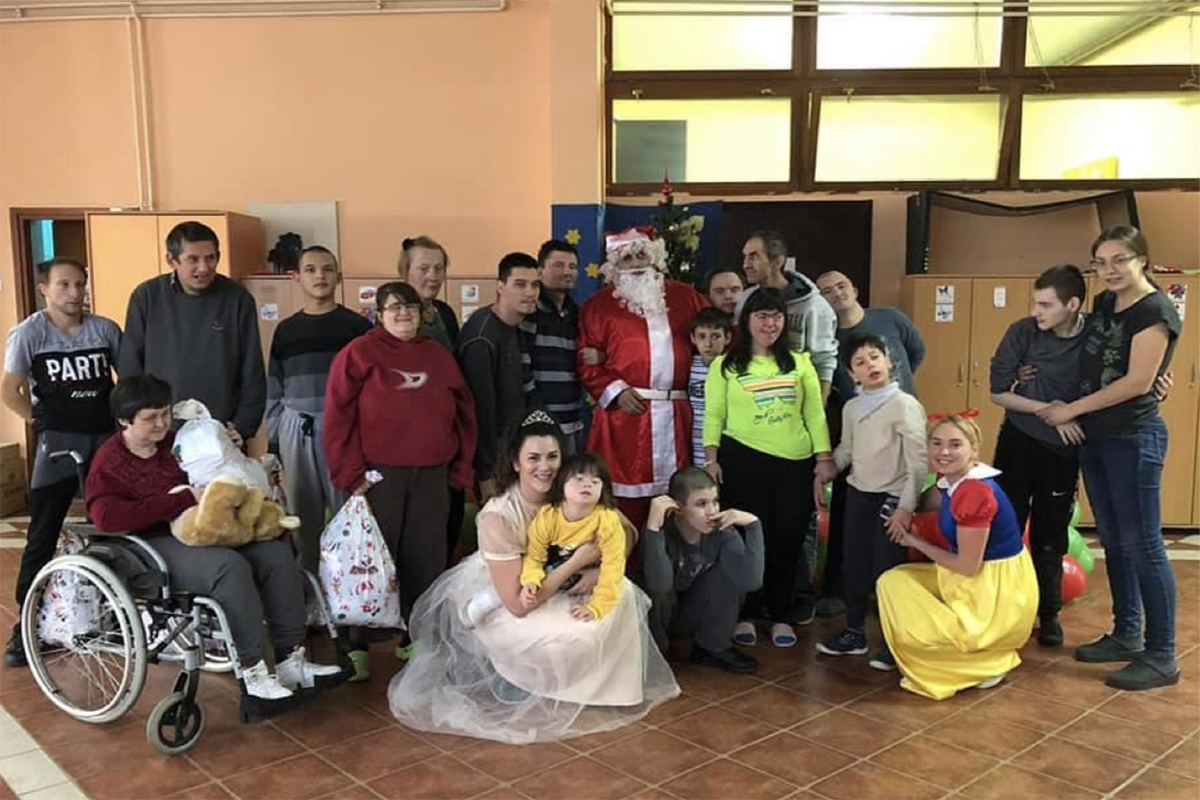
The words of the celebrated song Plava ptica (The Blue Bird), written some thirty years ago, stood up to war and to all the injustices of this world. One line from that song captures the motto of the association of the same name for persons with disabilities in Kula: I claim the right to fly like others. That was true back in 1996, when the association was founded, and it remains true today. This citizens’ association, which brings together parents, children and professionals working with children with developmental disabilities, campaigns for a more equal and more humane society.
Until 2001 Plava ptica ran only occasional activities. With the help of a Save the Children project, its members began meeting regularly again around a shared mission: providing health and social care to people with developmental and intellectual disabilities, helping them develop the skills needed to enter the labour market, and offering psychosocial support and assistance.
‘The association developed gradually. At first we had a day care centre for people with developmental, intellectual or multiple disabilities, and now it has grown into a substantial organisation. We now work with older people too, providing home care and assistance, and we have around 50 staff,’ Ivana Žažuljak of the association begins.
Plava ptica provides a range of services, grouped into day services and accommodation services. The day services include a day care centre for persons with disabilities and a counselling service for children, offering individual sessions with special educators. There is also a personal companion service for children and home care and assistance. The accommodation services include supported living and a residential community, currently undergoing the licensing process.
‘We are licensed for all the services except the counselling service, because that service is not defined in the regulations, yet there is a need for it in the community. The counselling service runs on a project basis and is funded by the local authority, and partly through user co-payments,’ Ivana explains.
Day care and supported living, she says, are of particular importance to persons with disabilities.
‘The day care centre operates every working day from seven in the morning until three in the afternoon. We have 30 service users, including children and young people. The youngest are seven and the oldest around 65. They are supported by preschool teachers, special educators, carers and nurses, and also by drivers, since we provide transport for everyone from home to the centre and back. We have two minibuses, and in the morning they collect people from across the municipality, including the surrounding villages,’ Žažuljak says.
The day centre, she says, has its own settled rhythm, with activities organised by age group and tailored to each participant’s abilities and support needs.
‘We have a group of children, then a group of the most independent service users, a group somewhere in the middle, and a group of people who are mostly non-verbal. Our preschool teachers and special educators work with them. The activities cover different areas of life, including speech and language development, understanding of the natural and social environment, digital literacy and practical life skills. All of this matters greatly if they are to be as independent as possible in future,’ Ivana explains.
She stresses how important it is to practise everyday things with them: how to hold a spoon properly, how to behave politely at the table, how to dress or put on shoes, how to put clothes away.
‘The more independent service users practise preparing simple food and drinks, such as making pudding, preparing tea or coffee and baking biscuits. They practise going to the shop, how to behave in a shop, how to behave on public transport and in other everyday situations. And we do not only simulate these activities on the premises; we genuinely go out into the community with people. For example, we take them to a café and practise how to behave there, how to order, how to pay the bill.’
They also teach them how to fill in payment slips for bills, so that they build up the routine and can manage as independently as possible at the post office or the bank.
Physical education is a compulsory activity at the day centre, since caring for physical health and fitness matters as much as everything else. But what the service users look forward to most, Ivana says, are the creative activities, above all the drama workshop.
‘For the past few years we have had a colleague with a real feeling for the dramatic arts, so every year she prepares a production with them, and it is all now at a higher level than it used to be. That is exactly why we founded the Festival of Dramatic Arts of Persons with Disabilities at the Cultural Centre in Crvenka. The festival lasts two days and draws a great many guests. We have had guests from Senta, Srbobran, Belgrade, Vrnjačka Banja,’ Ivana says with pride.
The service users show their pride in the association every day through their smiles and their attachment to it. That gratitude is shared by parents of children from neighbouring municipalities, who are not used to their family members receiving so much attention and respect. That this association truly offers more is shown by the trips it organises every year.
‘We have taken service users from the day centre and supported living to Divčibare several times, for example. They love it, and those are the moments when we really grow closer and become friends. I remember a boy with intellectual disabilities and attention deficit hyperactivity disorder (ADHD) who came with us once. He was restless, rebellious, sometimes more than we could manage. But there, at Divčibare, we had joint activities, and one evening everyone presented some talent or ability of their own. We organised something like a television show; one colleague played the presenter and the rest of us were the audience, the jury or the contestants. That boy sang us a song, and for the first time I saw so much emotion in him. There were even tears. Only then do you see how your work affects them, and that all of it makes sense,’ Ivana recalls.
She says the service users respond warmly to attention and to loud applause. At such moments they feel that someone values them after all, that they matter to someone.
‘These adults and children are used to someone always helping them. But when they have the chance to present something, to act, to do something for others, it really delights them. When they get praise or applause, sometimes there is a tear of happiness,’ Ivana says with a smile.
Although persons with disabilities are often invisible in society, thanks to Plava ptica and other associations in Kula it is no longer unusual in their community to see them walking down the street or sitting alone in a café.
‘My colleague Marko, the association’s director, told us that when he started out, while he was still a student and a volunteer, the first time he went to a café with the service users the waiter was quite taken aback. He asked Marko what he would like to drink, but not the others. There was no ill will in it; he had simply never been in a situation of serving people with disabilities before. But today all that has changed, and it is perfectly usual to see people with disabilities in cafés.’
Among its accommodation services, Plava ptica provides supported living and accommodation in a residential community. In this programme, supported living is available to people who do not need round-the-clock supervision.
‘We have two flats in the same building used for supported living, housing 10 people, with six in one and four in the other. The flat with six is for those who are less independent, while the other is for highly independent people who can manage, not quite everything, but who mostly just need reminding and some oversight. They need to be reminded to clean or vacuum, for instance, but they can and do know how to do it all themselves. Two carers work there in shifts,’ Ivana explains, adding that service users once had 24-hour supervision but are now independent enough to be on their own for part of the day and at night, calling if something unexpected or urgent happens.
For all these services to work, good cooperation with the local authority is essential. Plava ptica says the local authority understands the needs of people with disabilities, and that it can now point to record funding for social services.
‘Even though we meet with understanding, there is always that worry about how stable the finances are, and it varies from year to year. At the moment we want to expand the capacity of the residential community, where people live under constant supervision. Ten people live in the building, but the need is greater. And we would need more space for the day centre too. I am glad the residential community building is being renovated and that we will have room for six more people,’ Ivana says optimistically.
The staff at Plava ptica will always tell you that their work is more than a job. Even after years, it is hard to keep private and working life strictly apart.
‘That is how it is when you work with people. Especially with people you are fond of. Sometimes it is even hard to draw the line between what I can influence and what, unfortunately, I cannot. You give 100%. Sometimes I have wanted to take one of them home with me, I am so fond of them. Especially the children. We have a girl with Down syndrome at the day centre right now. I have known her since she was two, and now she has grown up and she is already at the centre. When I walk into the room she hugs me so tightly she will not let go, clinging on like a little sloth. So it is unrealistic to keep that strict professional distance,’ Ivana says, smiling.
And it is love that drives the people working at the association: love of people and of life, and the belief that together we can be a better and more equal society, one in which no one is invisible.
This story was produced under the project Strengthening Cohesion and Resilience in Serbia, supported by the United Nations Population Fund (UNFPA) office in Serbia.