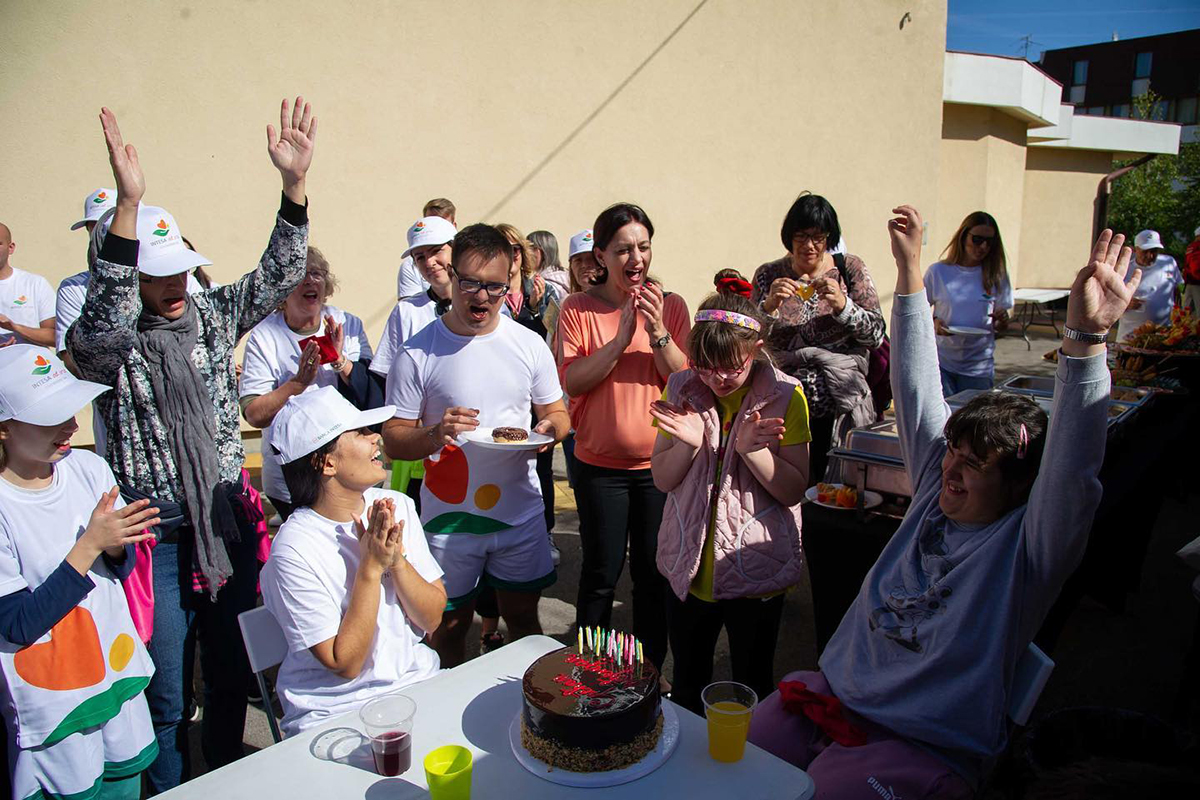
For a change, this story begins with good news. The Evo ruka association from Zemun has been given a large house with a garden in Nova Pazova.
‘More than 10 years of struggle lie behind our association, and we do everything we can to help children with developmental disabilities and rare diseases, and their families, to live with as much dignity as possible. And this year we really do have good news: two members of the Serbian community living in Norway, Igor and Jelena, a brother and sister, have given us their family inheritance in Stara Pazova. From this year our association owns its own house, and over the coming period we will renovate it and open another Inclusive Centre,’ Ana Knežević begins with a smile. She is the president of Evo ruka, founded by parents of children with developmental disabilities to improve their families’ quality of life and secure a better future for their children.
Ana recalls the association’s earliest days, when activities were run literally out of the boot of her white Golf II. Schools and the local community office lent them space at the time, but there was no lasting solution. They then fitted out a rented house in Zemun Polje, which they used for almost 10 years, until the owner terminated the lease and they had to move out. They currently work in Ana’s yard and on the premises of the Veljko Ramadanović school in Zemun, where they have equipped a club for young people with disabilities and family support. The association is building partnerships with faculties of social sciences, and young students of special education are glad to come and volunteer. During the school year the association runs sports workshops and workshops on social and life skills. The children are of different ages, which enriches the activities and gives them opportunities to build relationships and learn from different ways of interacting. Ana likes to say that here we all learn from one another.
In early September a mother from Novi Sad got in touch with news that there was a good man abroad who wanted to donate his family house in Pazova. Igor has lived abroad for a long time, and he and his sister agreed to give the property to someone who would put it to good use for the common good. The association and the donors met and immediately recognised their shared commitment to helping others. The association will soon begin work on the project ‘Evo ruka PAZOVA Inclusive Centre’, and will need the help of the whole donor community and of people of goodwill to achieve this ambitious goal.
‘The house is about 400 square metres, with enough space for all our activities. We plan to set up a centre for work and occupational activities, an occupational therapy area and a space for meeting and relaxing. Since we are already active in social entrepreneurship, all the work centre’s activities will follow the existing programme: preparing meals, making preserves, serving in the cafeteria, keeping the living and working spaces clean, packing gift boxes, making soap and handicrafts, art camps and so on,’ Ana adds.
Since it was founded, the association has developed activities to meet needs that were not being addressed in the community. One of the greatest challenges early on was how to organise day care for children during the school holidays, so that their parents could work and manage their daily commitments. This year the association ran the summer school programme for these children and young people with disabilities for the eighth year running.
‘It matters enormously that our children spend the holidays in a stimulating environment too. The day works like this: we gather in the morning, go shopping, cook lunch, prepare snacks, and then work on developing the children’s social and life skills. The day is enriched with creative work, but there is also time for free activities, watching television and playing,’ Ana explained, stressing that from the start the idea was not a programme that would burden a child during the holidays, but something more like coming to stay with grandparents in the country.
‘It is especially lovely when we go to the shop together. They choose the products, weigh the food. The best thing is seeing inclusion in action, when a ten-year-old girl with autism and a woman of 35 with Down syndrome go to the shop together and choose what to buy,’ Ana says, sharing one detail.
Around 25 families use the day care service over the course of a year. Those attending are children and adults aged 10 to 35.
‘The children differ in age and in the kind of disability they have, but that has proved to be a good thing, because it means they learn in practice to adapt and to learn from one another. They learn how to live in a community where there are differences, and rules. Parents are otherwise overwhelmed with running between doctors, taking children to therapy and finding the money for it, and they have no time to organise good activities for their children or simply to spend time with them,’ Ana said, noting that the organisation’s programme focuses more on building social connections among children with different disabilities.
‘It has turned out that one of the biggest problems is precisely that children with developmental disabilities generally have no friends. By that we mean real friends and real friendships, not ones based on someone’s goodwill and empathy. Through years of practice we have realised that it is not realistic to expect, still less to demand, that other children should be at the service of children with disabilities. That is why we have focused on activities that build friendships within their own community,’ Ana says, thoughtful and sad.
‘From personal experience, I think we should not rush at any cost towards some broader inclusion. We should work on developing support services for independent living from the earliest age, and approach everything on offer with caution. We have to be honest with ourselves and with others about how much strength we have, and preserve that strength and spend it carefully. I am thinking of parents who are with their children around the clock and in constant fear that they have not done enough for their child’s wellbeing. We are always meeting the idea that persons with disabilities want to be equal to everyone else. The truth is that they are not equal, and that if they are sometimes not accepted, it need not be anything personal. It is also true that the rest of us are not equal either, and that the whole system is not adapted to the individual who needs support. So I believe more in affirmative action than in equality in our society as it stands.’
Even so, the greatest need of all children is to have friends to spend time with. It is our duty constantly to create the conditions for good company in a safe environment.
‘There are all kinds of children, with different social and emotional intelligence and different degrees of socialisation, but what they all have in common is that they recognise kindness and compassion extremely well. They know unerringly who is sincere with them and who is putting it on,’ Ana stressed.
The Inclusive Centre is a place where children feel at home. The idea is a space where everyone will feel safe and comfortable. The progress in social interaction and the development of life skills, Ana says, is genuinely great, particularly among the children who come throughout the summer.
The centre also runs creative workshops, which the children always look forward to. Drawing, writing, colouring, cutting and gluing are always interesting to children and develop their creativity and focus.
‘It seems to me that we are always looking for innovative programmes, the very latest and most modern thing, when the most important thing is to let a child do what they enjoy and to follow their lead and guide them gradually. In our space we have one big shared table where, for at least an hour and a half a day, we always do something creative and educational, and we choose the subject spontaneously, together with the children.’
A programme like this brings benefits to children and parents alike. While caring for their children, parents often overlook their own needs. We often say that children with disabilities and developmental difficulties are invisible, but the paradox is that their mothers are even more invisible and far more stigmatised than the children.
‘In previous years we devoted a great deal of attention to empowering mothers, but this year we have gone a step further. We are going to set up a network of organisations supporting parents of children with developmental disabilities and rare diseases. Our network is designed to bring together organisations working on children’s rights and women’s rights. We are planning a great many activities: training for parents, awareness-raising campaigns, research into needs, and launching a podcast,’ Ana explained.
Building the support network goes hand in hand with continuous work to raise awareness of the problem even among mothers of children with disabilities, since these women often cannot recognise and articulate their own needs. Ana says mothers frequently come to her who have already become exhausted by the demands of caregiving and simply struggle to recognise when they need help.
‘I know that from my own case. As time passes and I get older, it is harder and harder to manage work, the household and my child, who is not sufficiently independent and needs both a carer and a home help. He needs someone to help him bathe, prepare his food, help him eat, then take him to school and study with him. I have to be the cleaner, the carer and the housekeeper, and do my own job as well. That is simply impossible. I cannot do it all alone. Every mother whose child has these support needs has the same problem. That is why help should be sought in time, before the body gives out,’ Ana warns.
Asked about the challenges the association faces, Ana says the biggest problems are the lack of support services in the community, financial sustainability, and too few active parents or partners.
‘The availability of social services has not changed for years. The range of services is not expanding. One service can exclude another: someone entitled to a personal companion for their child is not entitled to the Home Care for Children service. Very few local authorities provide home care at all, and our own research has shown it is the service these families need most from the outset, that is, from the moment of diagnosis. For example, we now have a situation where a child has a personal companion while at school. When they finish school they lose that entitlement, but do not automatically gain the right to a personal assistant. A child who could not function without a personal companion certainly will not manage without a personal assistant once school ends. And the problem lands back in the parents’ hands. There is also the problem that people with intellectual disabilities are not entitled to a personal assistant, which means that even those who could work cannot take a job. Everything is complicated, and every area and every stage of life brings new challenges.’
Despite all the challenges, Ana is not giving up. On the contrary. She fights with still greater energy for a society that gives both children with disabilities and their parents a life of dignity.
‘People who come to me often complain about the state. I like to say that we are the state. We choose what will happen; we are the ones who create policies. But people often do not understand that, and always expect some authority, some other people, to act on our behalf, recognise our needs and design policies, while we simply receive support. It does not work like that. We have to put our backs into it, and we have to do it together. I would like everyone to understand and accept that we are the driving force, and that the state is not some entity out there. The state is you and me, all of us. Our children are the state too, and that is how we will change the world,’ the president of Evo ruka concludes.
This story was produced under the project Strengthening Cohesion and Resilience in Serbia, supported by the United Nations Population Fund (UNFPA) office in Serbia.