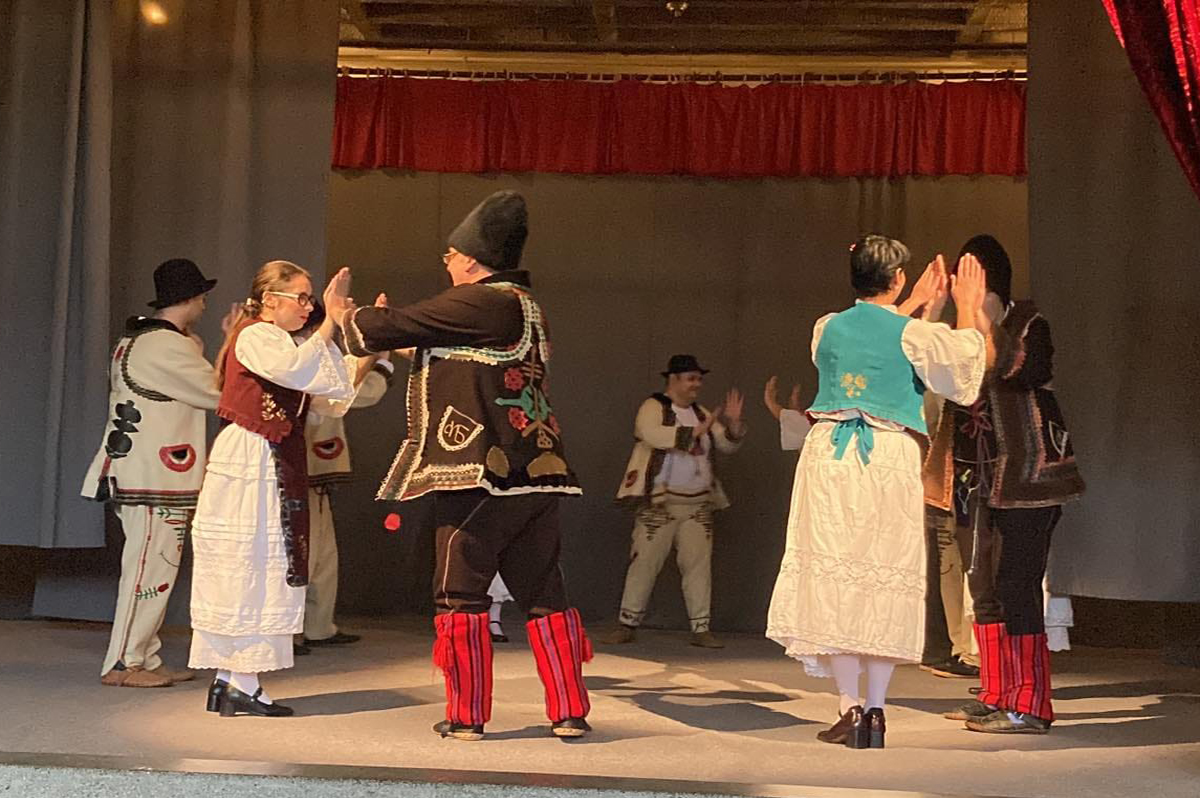
Having an open heart is a phrase we use often. The real meaning of those words, though, was shown to us by the members of Otvoreno srce sveta, an association in Vršac that supports children and adults with intellectual and developmental disabilities. The association began work back in 1979, founded by the parents of these children together with their teachers.
According to Marija Keri Kutlešić, a special educator and speech therapist, the association resumed its activities in 2005 after a long period of inactivity. The biggest problem was the lack of premises. Thanks to a fellow resident, Milan Popović, who donated a house to them, the association got its first permanent base. The funds for the full renovation and fitting out of the house came from many big-hearted people in Vršac.
‘You know how it goes: one neighbour helps, then a friend, and we collected the money. That is how the pieces came together, and three years ago we moved in and started working from these premises. At first we worked with young people aged from 15 to about 35, and in recent years with younger children too, because a need appeared for supporting children with developmental disabilities from the age of four until they start school. We prepare the younger children to enter mainstream education. That is, working with the parents, we try to find the educational setting that would suit them best,’ Marija says.
It is fair to say that this is one of the most creative associations in Serbia and the region. Alongside its work with preschool children and its counselling service for parents, the association runs many creative and educational workshops, and there is hardly anyone in Serbia who has not at least heard of the theatre productions, performances and concerts it organises, with its own members on stage. It devotes as much attention to innovative support programmes as it does to its methods. One important strand of the association’s work is with children who have attention deficit hyperactivity disorder (ADHD), a chronic condition that affects a great many children and can continue into adulthood.
‘We began running a programme similar to neurofeedback, called Play Attention. Children with attention disorders also have difficulties with learning, and our task is to work on improving their attention span, their executive functions and their behaviour. Working with this system is a pioneering venture for us, because it is not widely used here,’ says Marija, noting that the association draws on experience from Croatia, where it is widespread in both associations and schools.
As Marija explained, Play Attention is a system that looks very much like a video game, but without a mouse or joystick: the child controls it through attention.
‘There are five basic levels of the game that train a child’s attention. With the first one, for instance, you practise sustained attention. The child watches a dolphin swimming along the sea bed, and if their focus is good the dolphin dives down and collects gold coins. The moment their attention slips, it rises back up. Focus should not fall below 75%, which means the child must not have more than two impulsive and two incorrect responses,’ Marija explained, adding that even someone without attention difficulties sometimes finds it hard to stay focused and move through the levels.
Play Attention uses NASA technology adapted for education to improve attention, shape behaviour and develop cognitive skills.
Around 25 children and young people attend Otvoreno srce sveta each day. Group activities with the younger ones are organised in small groups so that every child gets the attention they need. A further challenge is that every child is different and therefore needs different support.
‘Their levels of ability are not the same. Some children are non-verbal or have delayed psychomotor development, some have emotional difficulties, some behavioural ones. Some children need help even to draw the brush across the paper when something has to be painted, while for others a suggestion is enough,’ Marija explained.
Danijela Jovanović, the association’s president, stressed how important it is to work with older children and young adults as well, because once they leave the education system there is nowhere for them to spend their time. They are simply invisible.
‘Young people are left to themselves, left at home, and the association is the only place where they can socialise. It is in fact the only place where they can spend time with others, the only place where they feel at home, where they are free, where they enjoy themselves and do what makes them happy,’ says Danijela, noting that the children and young people become emotionally attached both to one another and to the workshop leaders.
Asked how other children accept children with intellectual and developmental disabilities in shared settings such as performances, concerts, inclusive workshops and schools, Danijela answers that on the whole they get on well and accept one another, but that inclusion needs constant work.
‘One workshop is one workshop. It comes and goes. And it only happens because we take the children there and suggest a joint activity. It is very rare for children to be sensitive enough to join a shared inclusive activity by themselves. Even at a workshop you can see it clearly: someone will come over of their own accord, and that child is at ease, has no difficulty talking, sitting down, being with them. But there are still far more who keep a little to one side,’ Danijela says frankly.
‘I think the heart of the problem lies with parents and families. People are generally detached, and especially so when it comes to people with intellectual disabilities. They are nowhere to be seen, they are invisible. We try to change that, so that these children are accepted. If nothing else, at least that they are seen. People need to understand that they exist,’ Marija stressed, adding that even other people with disabilities can be hesitant towards people with intellectual disabilities.
Danijela Lela Rakić Nikolić, a preschool teacher and workshop leader who has been with the association for three years, joined the team saying, ‘I am here to do whatever needs to be done to support these children.’ Perhaps that sentence captures better than any other the open hearts of everyone working here. That is how she started running the creative workshops.
‘In the creative workshops we do all sorts of things, and we have realised these children can achieve a great deal if you work with them properly and regularly. It matters to us to give them a platform at every opportunity, precisely so that they are not invisible. They simply deserve to be active members of society. We noticed how much they enjoy the acting and music workshops. They love performing. Usually it is a combination of fairy tales in our own version and staging. The preparations are serious, and when we put on a play we meet throughout the year, we hold rehearsals. We try to involve every child in every workshop, which is very hard, precisely because they are all so different,’ says Lela, explaining that some children can play an instrument, some can sing, some can act, and everyone has a part.
And what is the local community’s role in supporting the association and the children? Our interviewees say they cannot complain, and that everyone responds willingly to their initiatives, particularly when it comes to cooperation with schools.
‘They recognise us and they accept our activities and invitations. As for the local authorities, they are like any authorities. They set aside some funds for us and for other associations, but it is not enough. For ten years now we have been pointing to the need for a day care centre. They cannot help us without a licence, and we cannot get licensed because we do not have the money for it. The licensing requirements are complex and cost money we do not have. And so we go round in circles,’ Marija says of the challenges.
What worries the association’s staff most, however, and above all the children’s parents, is what will become of these children when their parents can no longer care for them. Our interviewees say those fears are always present for parents, and that they change as the children grow.
‘Mostly they are fears about whether the child will ever speak, whether they will get into any kind of school, how they will manage with their peers, what their life will look like from here on. Parents really do think a great deal about what will happen to their children when they move from our system, which is protective up to a point, into an education system that is not nearly so protective. Will they be able to meet its demands? There are many fears, and our psychologist does a great deal of work with parents,’ Marija says.
Who will care for these children when their parents no longer can? This question cannot be left to parents and civil society organisations alone. It is a question for all of us, for society as a whole. These children need support if they are to have a life of dignity in the future, without having to move into residential institutions. That is why the Otvoreno srce sveta association in Vršac works to equip the children for as independent a life as possible. This feature was produced under the project Strengthening Cohesion and Resilience in Serbia, supported by the United Nations Population Fund (UNFPA) office in Serbia.